
Timothy Chooi and Ji Su Jung
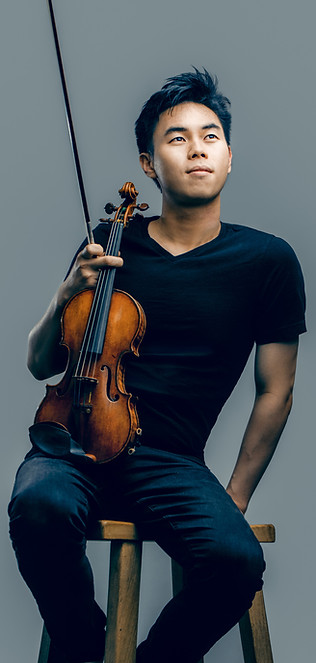
TIMOTHY CHOOI - VIOLIN
Internationally acclaimed violinist Timothy Chooi (pronounced “Chewy”) is celebrated for his passionate interpretations, emotional depth and dynamic stage presence. Praised for “dazzling the audience with a combination of flawless technique and heartfelt expression” (El Informador, Guadalajara), he has appeared with leading orchestras and at prestigious venues worldwide. Beyond the concert stage, Chooi is recognized as a cultural leader, committed to expanding access to classical music through education, outreach, and digital platforms that have reached millions of viewers worldwide. His artistry reflects the traditional roots of Asia, the elegance of European training and the openness of his North American upbringing—embodying the voice of a 21st-century violinist.
A laureate of some of the world’s most distinguished competitions, Chooi won First Prize at the Joseph Joachim International Violin Competition in Hannover, Second Prize at the Queen Elisabeth International Violin Competition in Brussels and the Yves Paternot Prize from Switzerland’s Verbier Festival. His career has been supported and mentored by luminaries including Pinchas Zukerman and Anne-Sophie Mutter, whose encouragement has helped shape his path as one of today’s leading violinists.
Chooi has collaborated with renowned conductors including Gianandrea Noseda, Jukka-Pekka Saraste, Michele Mariotti, Xian Zhang and Pinchas Zukerman. His orchestral partners include the Deutsches Symphonie-Orchester Berlin, Belgian National Orchestra, Royal Philharmonic Orchestra, Royal Liverpool Philharmonic, Wiener Concert-Verein and Toronto Symphony Orchestra.
He made his solo concerto debut at age 16 with l’Orchestre Symphonique de Montréal (OSM), launching a career that has since taken him to Carnegie Hall, the Berlin Philharmonie, Amsterdam’s Concertgebouw, London’s Royal Albert Hall and Suntory Hall in Tokyo.
The 2025–26 season marks a significant milestone in Chooi’s career, highlighted by his debuts with the NHK Symphony Orchestra and Tokyo Symphony Orchestra, as well as a major European tour with the Prague Radio Symphony Orchestra across Munich, Innsbruck, Paris, Antwerp, Eindhoven, Linz, and Prague. Other highlights include Hong Kong’s Generation Next Arts Festival; concerto engagements with the Calgary Philharmonic and other North American orchestras; his appointment as Artistic Partner of Wiener Concert-Verein for the 2025–26 season, including a concert at the Musikverein Wien and performances in France. Festival appearances include the Verbier Festival, Toronto Summer Music Festival and recitals in Vancouver, Brussels, Antwerp, Tokyo, Seoul, Ottawa, and New York City.
Chooi’s artistry is widely broadcast and recorded, including collaborations with Anne-Sophie Mutter and Mutter’s Virtuosi for Deutsche Grammophon, Medici TV features and appearances on NPO Radio Klassiek (Amsterdam), WQXR (New York), RTBF (Belgium), Swiss Public Radio, CBC Radio Canada, Deutschlandfunk Kultur and Danish Public Radio.
Born in Canada to Chinese-Indonesian parents, Chooi is now Professor of Violin at the University of Ottawa (Canada), where he received the Equity, Diversity and Inclusion in Research Award in 2025. His work emphasizes research in violin performance and classical music as a cultural connector, community engagement, accessibility and nurturing the future of the violin as a mentor and teacher.
Timothy Chooi performs on the legendary 1714 “Dolphin” Stradivarius, once played by Jascha Heifetz, generously loaned by the Nippon Music Foundation. He also plays the 1741 “Titan” Guarneri del Gesù (CANIMEX Group, Drummondville, Québec) and a 1761 Landolfi violin (University of Ottawa).
JIU SU JUNG - MARIMBA
The first solo percussionist to ever receive the prestigious Avery Fisher Career Grant, Ji Su Jung has a distinctive musical voice that is instantly recognizable for its depth and lyricism. Born in South Korea, Jung began studying marimba at age three, a rarity among percussionists. Since launching her career as a soloist, she has performed concertos with such leading orchestras and conductors as the Baltimore Symphony Orchestra with Marin Alsop, the Houston Symphony with Daniel Hege, the Colorado Symphony and the Colorado Music Festival Orchestra with Peter Oundjian, the Colorado Springs Philharmonic with JoAnn Falletta, the Sarasota Orchestra with Giancarlo Guerrero, and the Milwaukee Symphony with Ryan Tani. She was featured as a soloist with the Indianapolis Symphony as part of the 2024 Percussive Arts Society International Convention.
“Ji Su Jung's performance of the Kevin Puts Marimba Concerto was dazzling—filled with breathtaking virtuosity but also beautifully shaped with extraordinary color and nuance,” remarked conductor JoAnn Falletta about Jung’s performance with the Colorado Springs Philharmonic. Jung’s recording of the Pulitzer Prize-winning composer Kevin Puts’ Marimba Concerto, performed with the Baltimore Symphony and Marin Alsop, was released on the Naxos label in February 2023. Pizzicato said of the recording that “Jung elicits wide spectrums from the work with superior technical execution.”
Equally at home as a concerto soloist, recitalist, and collaborative artist, Jung has performed solo recitals in such venues as the Kennedy Center for the Performing Arts and the Lincoln Center for the Performing Arts’ newly renovated David Geffen Hall. She has collaborated with artists such as the Catalyst Quartet, Timothy Chooi, and Gilbert Kalish. She frequently performs with The Percussion Collective, an all-star collection of young percussionists, of which she has been a core member since its inception. Committed to expanding the repertoire for solo marimba, Jung has commissioned works by composers including Gabriela Ortiz, Dai Wei, and Soomin Kim.
In addition to receiving the prestigious Avery Fisher Career Grant in 2022, she is a previous recipient of first prize and audience choice award at the Houston Symphony’s Ima Hogg Competition and a top prize at the International Marimba Competition in Linz, Austria. She also appeared as a young artist in residence with American Public Media’s highly popular radio program Performance Today, hosted by Fred Child.
Recognized internationally as a pedagogue, Jung serves on the faculties of Curtis Institute of Music and Peabody Institute of The Johns Hopkins University. She has taught master classes at New York University’s Steinhardt School, the Shepherd School of Music at Rice University, Michigan State University, the University of Central Florida, Boston University Tanglewood Institute, and Beijing Central Conservatory in China, among other schools.
Jung holds a bachelor’s degree from the Peabody Institute of The Johns Hopkins University, where she attended thanks to a generous grant from The Brookby Foundation. She also holds a master’s degree and an artist diploma from the Yale School of Music, where she studied with Robert van Sice.
Jung is a musical ambassador for Adams Percussion, Pearl/Adams, Zildjian, Evans, and Vic Firth percussion companies.



Program
Movement II from Three Romances, Op. 94 Robert Schumann
(violin and marimba) (1810 - 1856)
Andante and Allegro from Sonata No. 2 in A minor, BMV 1003 J.S. Bach
(violin) (1685 - 1750)
Allemande, Sarabande, and Gigue from Suite in E minor, BWV 996 J.S Bach
(marimba) (arr. Ji Su Jung)
Intermission
Cedrus Gabriela Ortiz
(marimba) (b. 1964)
The Red Violin Caprices John Corigliano
(violin) (b. 1938)
Histoire du tango Astor Piazzolla
Bordel 1900 (1921 - 1992)
Café 1930
Nightclub 1960
(violin and marimba)
Program Subject to Change
Timothy Chooi is represented by Colbert Artists Management.
Ji Su Jung is represented by Curtis Artist Management at Curtis Institute of Music.
Program Notes
Robert Schumann was a German composer and music critic of the early Romantic era. Initially he studied law, but shifted his focus to music. He concentrated on composing following a hand injury that ended his dreams of becoming a concert pianist. In 1840 he married the talented pianist and composer Clara Wieck. This marriage inspired an incredibly fertile "Year of Song," in which Schumann wrote several masterpieces. His compositions are celebrated for their deep emotionality, literary connections, and whimsical characters. Schumann famously championed emerging talents like Frédéric Chopin and Johannes Brahms through his publication, the Neue Zeitschrift für Musik (New Journal of Music). Throughout his life, Schumann struggled with severe mental health issues. Following an attempted suicide in 1854, he spent his final years in an asylum.
Three Romances, Op. 94 (1849): Movement II, marked as Einfach, innig (simply, heartfelt), is a lyrical, emotionally intimate piece. This tender duet features a soaring melodic line with expressive tempo variations. Originally composed for oboe and piano, it is now often performed with other instrumentations.
Johann Sebastian Bach was a German composer of the late Baroque period. Born into a prominent musical family in Eisenach, he mastered the organ and violin, and served at several royal and church courts throughout Germany. For the last 27 years of his life, Bach worked as the Kantor at the St. Thomas Church in Leipzig. There, he was responsible for the musical direction of the city's main churches, composing an array of cantatas, oratorios, and sacred works. Deeply devout, he often signed his manuscripts with Soli Deo Gloria (Glory to God alone). Bach’s genius is defined by his mastery of counterpoint, harmony, and polyphony. His output spans over 1,000 compositions.
Sonata No. 2 in A minor, BMV 1003 (ca. 1720): The Andante and Allegro are the final two movements of this sonata, which was part of Bach’s groundbreaking Six Sonatas and Partitas for Solo Violin. These movements represent a pinnacle of solo polyphonic writing, requiring the performer to simulate multiple voices simultaneously on a stringed instrument. The Andante third movement’s defining feature is a steady, pulsating bass line of unbroken eighth notes. The performer must play this continuous ostinato while concurrently playing a floating, lyrically expressive melody over the top. The Allegro final movement is fast and highly kinetic, composed primarily of rapid, flowing sixteenth notes. Bach skillfully writes dynamic "echo" contrasts into the score. Phrases are repeated with immediate loud and soft alternations, and with relentless forward momentum.
Suite in E minor, BWV 996 (1708 - 1717): The Allemande, Sarabande, and Gigue are the core structural movements of this Suite, which is believed to have been written for the lautenwerck (lute-harpsichord). Together these three traditional Baroque dances exemplify the dramatic shifts in tempo, rhythm, and emotion that define the classical suite structure.
The Allemande (movement II of the Suite) is stately, flowing, and moderate in speed. It features continuous sixteenth-note figurations and complex counterpoint, establishing the Suite's harmonic foundation right after the opening Prelude.
The Sarabande (movement IV of the Suite) is slow, somber, introspective, and highly expressive. It features elegant ornamentation, rich chords, and lyrical lines that provide room for rubato (subtle shifts in tempo) and individual expression.
The Gigue (Movement VI of the Suite) is fast, lively, energetic, and rhythmic, functioning as the finale of the entire work. It utilizes driving rhythmic patterns, syncopation, and a playful, dance-like dialogue between upper and lower voices.
Gabriela Ortiz was born in Mexico City into a family of musicians. Their house was full of music, everything from Beethoven to mariachi. Once Ortiz began to take piano lessons she encountered the music of Béla Bartók, whom she recalls as one of the most important composers in her life. His music helped her realize that: “Rhythm is very important in my music. I conceive rhythm in terms of pulse. I think that in Europe, sometimes the way they feel the rhythm is in terms of durations, but for me, pulse is extremely important.” Award-winning Ortiz is one of the most prominent voices in contemporary classical music today. Known for seamlessly blending traditional Mexican folk influences, jazz, and avant-garde classical styles, she has achieved significant global acclaim. She was named the 2026 Classical Woman of the Year by Performance Today and has been a winner of multiple Grammy Awards. In academia she continues to pass on her expertise as a Professor of Composition at the National Autonomous University of Mexico (UNAM).
Cedrus (2023), written for solo marimba, was commissioned by the award-winning marimbist Ji Su Jung, who performed its world premiere in 2024, at the Curtis Institute of Music. The piece explores the marimba's expressive depth, drawing on Ortiz's ongoing interest in environmental themes and nature. The metaphor of Cedrus (the cedar tree) serves as a reflection of deep-rooted resilience, endurance, and organic growth. The work utilizes the marimba's percussive attack and sustained resonance to create shimmering lyricism. It alternates between introspective, calm meditations in the upper registers and explosive, virtuosic, and rhythmically driven passages that require the performer to navigate complex, rapid ostinatos. The music is notable for its demanding pacing, with relentless, overlapping octaves that require deep, highly controlled performance, ultimately melting into a dynamic and thrilling finale.
John Corigliano is an acclaimed American composer celebrated for his dramatic, highly expressive, and broadly accessible style. Born in New York City to a musical family, he studied at Columbia University and later served as Composer-in-Residence for the Chicago Symphony Orchestra. Corigliano’s prolific catalogue spans over one hundred works. He has won numerous prestigious recognitions, including the 1991 Grawemeyer Award for his Symphony No. 1, the 2001 Pulitzer Prize for his Symphony No. 2, and multiple Grammy Awards. He also received an Academy Award for his evocative score to the 1998 film The Red Violin. Beyond composing, Corigliano is a dedicated educator on the composition faculty at The Juilliard School.
The Red Violin Caprices (1999) is a highly virtuosic work for solo violin. The piece is directly derived from his score for the film The Red Violin. Corigliano composed the core musical elements before the movie was filmed so the actors could synchronize their movements to the music. The piece takes a spacious, troubadour-inspired theme and a dark, seven-chord chaconne, viewing them from different stylistic angles. The variations intentionally evoke baroque, gypsy, and romantic idioms. The Caprices are ordered to reflect the multi-century narrative of the film, tracking a fictional, blood-varnished instrument from 18th-century Vienna, to modern-day Montreal.
Astor Piazzolla was born in Argentina, but raised in New York City. He returned to Argentina at the age of 16, and began giving concerts on the instrument with which he was most identified - the bandoneon (an accordion-like instrument traditionally played in tango music). Piazzolla began his studies of classical music with Alberto Ginastera, and wrote a symphony for the Buenos Aires Philharmonic, which won him a scholarship to study in Paris with Nadia Boulanger. Although Piazzolla had hopes of becoming a mainstream composer like the others who flocked to Boulanger - among them Leonard Bernstein, Aaron Copland, and Virgil Thomson - Boulanger encouraged him to write tangos rather than compose in the more academic European-oriented style. And write tangos he did; the variety of Piazzolla’s 3,000 works is astonishing, and virtually everything he wrote was based on the tango. His compositions introduced dissonance, chromatic harmony and a much wider range of rhythm than the traditional tango had used, as Piazzolla successfully crossed boundaries between music genres.
Histoire du Tango (1985) is a famous four-movement suite, originally written for flute and guitar. It serves as a musical history book, charting the evolution of the tango from a subculture dance in the slums of Buenos Aires to a sophisticated art form celebrated on international concert stages.
Bordel 1900 represents the origins of tango in the brothels and suburbs of Buenos Aires at the turn of the century. The music is fast, cheerful, and full of rhythmic vitality. It mimics the early street style where the tango was purely for dancing.
Café 1930 marks a shift where tango moved from dance halls into cafes. People stopped dancing to sit and listen. The music is slow, melancholic, and deeply expressive, featuring long, romantic melodies.
Nightclub 1960 reflects internationalization. This era fused traditional tango with Brazilian Bossa Nova and American jazz in cosmopolitan clubs. The music is rhythmically complex, modern, and highly synchronized. It showcases Piazzolla's signature aggressive accents and evolving harmonies.
(Note: The suite finishes with a fourth movement, Concert d'aujourd'hui (Modern Concert), which pushes the tango into 1980s contemporary classical music.)